





Related Posts with Thumbnails

Showing posts with label Toting Bunye. Show all posts

Sunday, March 21, 2010

El Niño toll on farmers

THE ongoing El Niño phenomenon has truly taken a toll on our local farmers. Television newscasts and the banner stories of newspapers describe in vivid detail how the extreme heat brought about by the warmer-than-normal sea surface temperature in the Pacific Ocean has dried up farmlands, reservoirs and waterways in the country.

The lack of rainfall and irrigation water has narrowed the options for Filipino farmers, who now use whatever water they have as wisely as possible.
The recent issuance of a Bangko Sentral ng Pilipinas circular allowing all banks in the country to offer micro-agri loans for farmers could not have come at a much better time.

Circular No. 680, which lists the rules and regulations for the provision of micro-agri loans, will provide an opening for small farmers to tap any bank for their financial needs without having to go through complicated loan application procedures.

The significance of such a circular cannot be discounted.
The Philippines is primarily an agricultural country with a land area of 30 million hectares, 47 percent of which is agricultural land.

According to the Department of Agriculture (DA), the country’s population is predominantly rural (70 percent of the total) and two-thirds of this population depends on farming for their livelihood.
In terms of employment, about one-half of the labor force is engaged in agricultural activities.

The DA also noted that majority of the farms in the country are small ones, averaging two hectares in size. These small farms are owned and managed by single families involved in agricultural activities ranging from subsistence to commercial production.

A typical farming system consists of major crops, with rice, corn and coconut as common base crops, and a few heads of livestock and poultry.
Sadly, small farmers often find it difficult to borrow money from banks. To be able to access bank credit, farmers usually undergo complex application procedures which require the submission of financial statements and proof of tax returns.
They are also required to provide traditional collateral such as land titles, which many small farmers do not have.

Micro-agri loans can provide farmers the needed relief. Micro-agri loans will not require the usual collaterals that banks ask of their clients. Depending on the bank, farmers could present unconventional collateral substitutes such as their farm animals or crops.

Farmers who apply for loans as a group can use “peer pressure or peer support” as their collateral, or they could ask their colleagues to be their co-makers.
To be eligible for a loan, farmers should have a good track record and multiple income-generation activities (aside from farming) to mitigate the risks of non-payment.

Their farm activities should also have been at least two years in operation at the time of the loan.

The farmers would be allowed to borrow up to P150,000, with the bank requiring them to pay their loan on a regular (weekly, semi-monthly or monthly) basis.
Farming in itself is risky: A good harvest depends on the weather, the climate, and the absence of pests. With the looming El Niño phenomenon, our farmers now need all the help they can get.

For comments and suggestions, please email totingbunye2000@gmail.com.

Read more...

Sunday, March 14, 2010

Mobilizing our savings


THE recent passage of a law making life insurance more affordable for Filipinos is a welcome development for those who wish to invest in their future.
By reducing taxes on insurance premiums, Republic Act 10001 will enable more Filipinos to purchase life insurance – financially preparing them and their families in the event of unforeseen circumstances such as illness and death.


This legal measure is not only seen to increase the sale of life insurance, it is also expected to play an important role in savings mobilization.
Together with the recent passage of Republic Act 2505 or the Personal Equity and Retirement Account (PERA) Act, and Republic Act 9576 or the law amending the charter of the Philippine Deposit Corporation (PDIC), Republic Act 10001 helps create an environment conducive for saving.
I wrote in a past column about how the PERA Act will allow Filipino workers to prepare for their retirement by having a special savings account invested by professional fund managers.


Republic Act 9576, on the other hand, increased the maximum deposit insurance coverage from P250,000 to P500,000 as a preemptive response to the global financial crisis. More significantly, this has helped allay the Filipino depositors’ fears of losing their hard-earned savings and encourage them to save more in the bank.
So what is savings mobilization? It is how the authorities formulate and implement policies that urge us to prioritize investment over consumption.


To do this, we save our money in banks, insurance companies, or other financial institutions.
These institutions serve as channels for spurring economic growth through their lending to companies and enterprises that in turn generate more employment and other economic activities.


According to the PDIC, there is a need to raise the rate of investments to enable the Philippines to move toward a higher economic growth path. Investments, the PDIC says, require financing through savings generated from domestic and foreign sources. The PDIC notes, however, that foreign sources are unsustainable and increase the country’s vulnerability to international capital flight.


Thus, PDIC recommends that the expansion of domestic savings should be enhanced as a necessary condition to boost capital formation Mobilizing our savings and achieve sustained economic growth.
Savings are commonly understood as the portion of income left after deducting all expenditures and payment of liabilities for a given period. The money left is usually set aside and kept in banks to earn interest.
By investing our savings in banks, we are rewarded with “investment returns” in the form of interest. This is because our banks also invest the money we deposit in construction, housing, or business loans.
Through these loans, companies and businesses would have sufficient money to fund their activities – endeavors that would have a long-term effect on the economy.


Investing in a PERA account or in a life insurance would also bring about the same desired outcome: By investing one’s money in investment products, the life insurance company or the professional fund manager (in the case of PERA) would, in the long run, spur economic growth.
******
Note: You may email us at totingbunye2000@gmail.com. Past articles may be viewed at http://www.speakingout.ph.

Read more...

Sunday, March 7, 2010

Islamic banking in the Philippines


 Financial institutions and products designed to comply with the central tenets of Sharia are among the fastest growing segments of the global financial industry. The number of Islamic financial institutions worldwide now exceeds three hundred, with operations in 75 countries and assets in excess of US$400 billion.
NOT many of us are aware that there is such a concept as Islamic banking, and that there is actually a special bank for our Muslim brothers and sisters.

In a country like the Philippines where there is a significant Muslim population, this financial system is indeed very important.
Islamic banking pertains to a system of banking that is consistent with the principles of Sharia (Islamic law). In this type of banking system, the collection and payment of interest, which Muslims refer to as “riba,” is strictly prohibited.

Islam forbids transactions involving interest because of its teachings that all income must be determined by the supply of work associated with the factors of production. It emphasizes that if money is lent for interest, capital is consequently augmented without any effort.
Profit-Loss sharing in Islam encourages Muslims to invest their money and become partners in order to share the profits and risks of the business.

Islamic law prohibits investing in sectors contrary to Islamic values such as gambling, alcohol, tobacco, the arms industry and pornography.
In an Islamic mortgage transaction, instead of loaning the buyer money to purchase the item, a bank might buy the item itself from the seller and resell it to the buyer at a profit, while allowing the buyer to pay the bank in installments.
The Philippines actually pioneered in Islamic banking with the creation of the Al- Amanah Islamic Investment Bank of the Philippines in 1973. Al-Amanah even antedated the establishment of the Dubai Islamic Bank in 1975.
However, for a variety of reasons, principally lack of expertise in this new field and lack of general public awareness, Al-Amanah failed to really take off the ground.
In the 1980s, the Government of Malaysia and Bank Negara begun actively promoting Islamic banking in Malaysia. 

The following decade saw the development of a regulatory regime for Islamic Financial Institutions by the Central Bank of Bahrain.
Financial institutions and products designed to comply with the central tenets of Sharia are among the fastest growing segments of the global financial industry. The number of Islamic financial institutions worldwide now exceeds three hundred, with operations in 75 countries and assets in excess of US$400 billion.

Islamic banking has also been estimated to be growing by as much as 20% a year, largely fuelled by wealth from oil.
With these developments, interest in Islamic banking has been rekindled. With Monetary Board approval, the Development Bank of the Philippines recently obtained full control of  Al-Amanah Islamic Investment Bank by acquiring the national government’s 69 per cent stake in the bank.
Forward-looking DBP President Rey David sees in Al-Amanah a new opportunity for DBP to expand its SME operations in Mindanao as well as other banking services to include remittances especially from the Middle East.

DBP has already sent 15 top executives to Malaysia to hone up their skills in Shariah banking.
Rey David believes that under new management, the refurbished and rebranded Al-Amanah could serve as gateway to Brunei, Indonesia, Malaysia and to the economies of other Muslim countries.
•••
For comments and suggestions, please email totingbunye2000@gmail.com.

Read more...

Sunday, February 28, 2010

Micro-agri loans for farmers

THE ongoing El Niño phenomenon has truly taken a toll on our local farmers. Television newscasts and the banner stories of newspapers describe in vivid detail how the extreme heat brought about by the warmer-than-normal sea surface temperature in the Pacific Ocean has dried up farmlands, reservoirs and waterways in the country.

The lack of rainfall and irrigation water has narrowed the options for Filipino farmers, who now use whatever water they have as wisely as possible.
The recent issuance of a Bangko Sentral ng Pilipinas circular allowing all banks in the country to offer micro-agri loans for farmers could not have come at a much better time.

Circular No. 680, which lists the rules and regulations for the provision of micro-agri loans, will provide an opening for small farmers to tap any bank for their financial needs without having to go through complicated loan application procedures.

The significance of such a circular can not be discounted. The Philippines is primarily an agricultural country with a land area of 30 million hectares, 47 percent of which is agricultural land.

According to the Department of Agriculture (DA), the country’s population is predominantly rural (70 percent of the total) and two-thirds of this population depends on farming for their livelihood.
In terms of employment, about one-half of the labor force is engaged in agricultural activities.

The DA also noted that majority of the farms in the country are small ones, averaging two hectares in size. These small farms are owned and managed by single families involved in agricultural activities ranging from subsistence to commercial production.

A typical farming system consists of major crops, with rice, corn and coconut as common base crops, and a few heads of livestock and poultry.
Sadly, small farmers often find it difficult to borrow money from banks. To be able to access bank credit, farmers usually undergo complex application procedures which require the submission of financial statements and proof of tax returns. They are also required to provide traditional collateral such as land titles, which many small farmers do not have.

Micro-agri loans can provide farmers the needed relief. Micro-agri loans will not require the usual collaterals that banks ask of their clients. Depending on the bank, farmers could present unconventional collateral substitutes such as their farm animals or crops.

Farmers who apply for loans as a group can use “peer pressure or peer support” as their collateral, or they could ask their colleagues to be their co-makers.
To be eligible for a loan, farmers should have a good track record and multiple income generation activities (aside from farming) to mitigate the risks of non-payment. Their farm activities should also have been at least two years in operation at the time of the loan.

The farmers would be allowed to borrow up to P150,000, with the bank requiring them to pay their loan on a regular (weekly, semi-monthly or monthly) basis.
Farming in itself is risky: a good harvest depends on the weather, the climate, and the absence of pests. With the looming El Niño phenomenon, our farmers now need all the help they can get.
--------------
For comments and suggestions, please email totingbunye2000@gmail.com.

Read more...

Sunday, February 21, 2010

Case of the missing coins

FIVE years ago, the Monetary Board of the Bangko Sentral ng Pilipinas created a special committee to address the problems arising from the circulation of Philippine currency—challenges which persist up to the present.

  BSP Governor Amando Tetangco Jr., who was then the first chair of the Currency Management Committee (CuMC), stressed the importance of creating such a committee because of three main concerns: the perceived shortage of coins in some regions in the country, the indications that coins are not being circulated effectively, and the need for BSP to produce more coins to make up for those not in circulation. The production cost runs into millions of pesos.

  Last week, I discussed the main reason behind the country’s perennial shortage of coins, particularly the lower-denominated ones: the negative attitude and low regard for small currency.
  Instead of using coins to purchase goods (and in effect circulating them in the market where they rightfully belong), many Filipinos consider them as “excess baggage” and leave them at home.
  The practice of keeping coins in piggy banks for a long time also leads to this artificial, but persistent, shortage of coins.
  The BSP sees another reason behind this problem: coin smuggling.
  Dr. Paterson Encabo, head of BSP’s Mint Refinery Operations Division (MROD), explained that in the last two years, there have been some attempts to smuggle out coins, particularly 1-piso, because of the increased international demand for copper and nickel.
  Encabo explained this was because of the higher metal content of 1-piso coins belonging to an earlier series. The earlier 1-piso coin was then worth P1.50 because of its nickel and copper content.
  “However, the metal composition of today’s P1-piso coin should discourage smugglers. It is now made of nickel-plated, low-value steel,” Encabo said.
  Just the same the cost to produce the same 1-piso coin, considering metal content plus production cost, is much more. We spend approximately P1.55 for every 1-piso coin. Metal content accounts for 0.75 centavos while production cost amounts to roughly 0.80 centavos.
  Thus, coin production for the 1-piso coin would entail negative seigniorage.
  Seiniorage is  the difference between the coin’s total production cost (cost of the metal + labor) and the coin’s face value. When the production cost of the coin is greater than its nominal value (especially for the lower denominated coins, such as 25-, 10- and 1-sentimo), negative seigniorage is incurred.
  Thus the Currency Management Committee, now headed by Deputy Governor Diwa Guinigundo, continues to look for ways and means not only   to efficiently produce notes and coins, consistent with the requirements of the economy, but also to ensure that that coins are effectively circulating.
  All banks are encouraged not look at coin deposits as “labor-intensive”. Instead, banks are persuaded to even encourage their clients to deposit and save their small currencies with them.
  Both the retail sector and the Filipino public, on the other hand, should adopt a positive attitude toward our coins and make sure to use them whenever they can.

Read more...

Sunday, January 31, 2010

Supreme Court ruling on credit card charges


TECHNOLOGY is a double-edged sword. While offering the utmost convenience to users, misuse or abuse can easily put users in difficult situations.

One such example is the credit card. As the Bangko Sentral ng Pilipinas’ Financial Consumer Affairs Group (FCAG) always reminds credit card owners, “It is easy to swipe it, but how do you wipe it?”

Credit card users should be aware that there is no BSP existing regulation which puts a ceiling on fees, charges and interest rates.

The then Central Bank of the Philippines, through Circular No. 905, had removed the ceiling on interest rates on loans or forbearance of money, goods or credit, for both secured and unsecured loans and regardless of maturity.

While the Monetary Board is not precluded from issuing subsequent circulars reimposing a maximum interest rate on a loan or forbearance of any money, goods or credits, whenever warranted by prevailing economic and social conditions, the Monetary Board is not inclined at present to lift Circular No. 905.

The Monetary Board currently thinks it is enough that banks and their subsidiary credit card companies properly disclose finance charges and interest rates to cardholders and thus help cardholders make informed choices and decisions.

While in a recent decision the SC reduced the interest rate and penalty fee imposed for unpaid credit charges for being “iniquitous and unconscionable”, this ruling can not be invoked universally. (See Macalinao v. BPI, G.R. No. 175490).

In other words, an aggrieved credit card holder still has to go to court. And courts still have to consider the circumstances of each case since what may be inquitious and unconscionable in one may be totally just and equitable in another.

By way of background, the Supreme Court partially granted the petition of a credit card user, who had faced a lawsuit from a credit card company for failing to settle unpaid charges.

The high tribunal ruled that the credit card company’s interest rate and penalty fee of 3 percent per month or 36 percent per annum, which were charged to the user, should be reduced to two percent per month or 24 percent per annum.

The Supreme Court decided that although the credit card’s terms and conditions stipulated the three percent interest rate, the courts may reduce the interest rate and penalty charge as reason and equity demand.

The Supreme Court also considered the user’s partial payments and decided that the interest rates stipulated by the credit card company in its terms and conditions are iniquitous and unconscionable.

In the United States, credit card users are protected from sudden hikes in interest rates by new rules issued by the Federal Reserve.

The new Fed rules, which take effect next month, generally prevent rate increases during the first year after an account is opened. After the first year, companies must provide customers with a 45-day notice before increasing interest rates.

The BSP’s FCAG, headed by acting deputy director Ma. Belinda Caraan, has repeatedly stressed that the key for card users to avoid excessive finance charges, fees and penalties is to be responsible by paying their bills on time to avoid late payment fees and penalties, and as much as possible, try to pay off all outstanding dues every billing cycle.

Spending within your means, according to FCAG, is the surest way to avoid finance charges and continue to enjoy using your credit card.

For comments and suggestions, email totingbunye2000@gmail.com.

Read more...

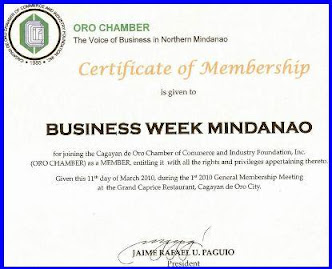
2) NEW ORO CHAMBER MEMBERS. BusinessWeek Mindanao Publisher Mr. Dante Sudaria, Reynaldo Kangleon, general manager of Fast Laboraries, Erna Maagad, officer-in-charge of Equicom Savings, Luz Gonzaga Ramos, business development officer of Sameah Travel and Tours, and Noel C. Martinez of Barkadahan Grill, take their oath as new members of the Cagayan de Oro Chamber of Commerce and Industry Foundation, Inc. (Oro Chamber) during its First Membership meeting of the year at Grand Caprice Restaurant, Limketkai Center, this city, on Thursday. PHOTO BY ROLANDO SUDARIA

OUR ADVERTISERS

Name:
Give Us Your Feedback
Email Address:

Get your own free form like this one.

  © Blogger templates The Professional Template by Ourblogtemplates.com 2008

Back to TOP