
Related Posts with Thumbnails

Showing posts with label Roy Gaane. Show all posts

Saturday, March 27, 2010

Filipino food in California

WHEN we first arrived in the U.S. in 1977, we settled in San Diego, California known to be a Navy town. Many Filipinos enlisted in the U.S. Navy. The presence of Filipinos in San Diego plus our relatives and friends made us feel a bit at home. In spite of the Filipino population in San Diego, there were no Filipino stores and restaurants. For groceries, we had to drive to downtown San Diego and bought our food stuff, specially rice from a Chinese store called Wo Chee Chong. From other Filipino friends we learned to be creative in cooking Filipino food. We had to learn substitutes for Filipino vegetables, spices and ingredients.

There was one tiny restaurant that served breakfast for $1.99 with toast, bacon and eggs. We would sometimes have breakfast there. The owners were Filipinos who later became our friends. One day, I suggested to them to convert their eatery into a Filipino restaurant but they said, it would not prosper because there would not be enough Filipino customers. Within a year, another Filipino couple bought the restaurant from them and called it “Point Point” or “turo-turo” in our lingo. It was a hit. There was always a long line of customers and the tiny restaurant with only 2 tables could not accommodate its Filipino patrons. Most of the orders had to be take-outs. That was the first Filipino restaurant that I knew in California. The owners would later open a branch in Los Angeles.

It would take almost a year before more Filipino restaurants, sari-sari stores opened in California.
Today, in West Covina alone, there is one block of business establishments that are 85% Filipino owned. To its north is another block with more Filipino business establishments. To the west are more Filipino businesses. The city of West Covina has to name its north entrance “Manila Way”. In these 3 blocks are 4 Filipino bakeries specializing in what else but hot pandesal. There are 9 restaurants not to include the little ones inside the 2 large groceries of Seafood City and Island Pacific. There are 3 money remittance centers. Bank of America is there too and it has officers and tellers who are Filipinos. There are gift shops, beauty parlors, sari-sari stores and not so glamorous are sidewalk vendors. The two competing giant groceries have Filipino fresh produce like kalamongay, tanglad, tangcong, ampalaya, sitaw, upo, patoloa, clamansi and even banana blossoms that ridiculously sell at $4.50 a piece. Banana leaves are also sold for those who make suman and other goodies that use banana leaves. Incidentally, some of these fresh produce come from the farms and backyards of enterprising Filipinos.

One of our friends, the late George Larsen of the Cepeda family, used to grow vegetables in his backyard. His favorite was sitaw (string beans). He had more than enough for his own consumption. So when it was time to harvest, he would call us and other Kagay-anon friends to help him harvest. Then there is Vic Raagas whose hobby was fishing. He would catch lots of fishes, dry them and would give us and other friends his bulad. When we moved to Los Angeles, Joe Pimentel also used to fish and make bulad that he would give to his friends. But today Filipino vegetables and bulad are available in the groceries. I also learned how to make “hipon guinamos” that I would package and give as Christmas presents.

Aside from the restaurants available in California, there are many Filipino American caterers that include lechoneros. But some lechons are baked. Others are roasted. You can tell that a lechonero is from Mindanao because the lechon would be filled with tanglad (lemon grass). Unfortunately, there is no lechon de leche available because it is not allowed in California to slaughter a piglet. That’s what a lechonero told me.

Last Sunday, Gerlou and I had breakfast in Bamboo Bistro which also offers lunch and dinner buffet. But if we really want a classy restaurant in West Covina offering fine dining, we go to Pondahaan or Salo-Salo along California and Amar streets, respectively. For fine Filipino pastries, no one should miss Manille also along Amar Road. Manille was once featured on TV in Los Angeles.

And that’s as far as I know.

Read more...

Sunday, March 14, 2010

Filipino American retirees


Discussing politics is a favorite pastime among Filipino American retirees and those with nothing to do.
They discuss Philippine and American politics.  They argue which are the best approaches to “solve” the problems of the Philippines and America.  Like most Filipino Americans, some of them  are diehard Republicans and some are diehard Democrats.  Some are for Aquino, Villar and Teodoro.   Definitely not for Erap. 


In West Covina where I reside, there is a donut shop where they congregate.  But their favorite meeting place is under a magnolia tree near Seafood, a Filipino-owned grocery.  This, by the way, is just one of the chain of groceries scattered all over California.  In this location are other Filipino establishments ranging from restaurants to gift shops.  But this will be another story.


When the sun is out which is often in West Covina these seniors bring their chairs, a table and sometimes a portable stove to cook their “polutans” or merienda.  This usually happens when one of them is celebrating a birthday.  They occupy a parking space which is not legal but nobody brings it to their attention.   I guess people just like to see them congregate.  They have an informal name which is “Under the Tree Cub”.  


Pictured in this page are a few of the retirees on a chilly weekday.   There are many more of them on a weekend. They are from Cebu, Iloilo, Bulacan and Manila.  They live around West Covina. 
There are only 30,000 registered Filipino voters in the U.S.   With 46 million registered voters in the Philippines, the 30,000 will not make a dent in the election results.  Still these retirees under the tree are passionate about their politics.  But aren’t all Filipinos passionate about their politics?


In the United States, Filipino Americans have attained successes in elections.  The highest position that a Filipino American has attained is that of Governor when Benjamin J Cayetano was elected in Hawaii.  Others have been elected as Congressman, Mayor and Councilmen.  So far nobody has yet been elected Senator.  Gene Canque Liddell became Mayor of Lacey, Washington;  My friend and fellow Atenean Tony Cartagena became Mayor of Walnut, California. There’s Congressman Steve Austria of Ohio and many more.
And that’s as far as I know.

Read more...

Sunday, March 7, 2010

More on caregivers in the United States

DUE to some positive interests I received via email about my article on caregivers, I am putting in a rejoinder.

Who work as caregivers? First it is a misconception that all caregivers in the U.S. are illegal residents. There are U.S. citizens and green card holders who work as caregivers because of the pay. Singles with no family in the U.S. and do not want to pay rent also like to work as caregivers.

What’s more, they love what they do. There are also Filipinos who come here as tourists who work as caregivers then go back home before their tourist visa expires.
They work as caregivers because that’s the best job they can find since by U.S. laws they are not supposed to work in the U.S. Non-green card holders who are non-English speakers work as farm laborers, kitchen workers and other menial jobs.
Yes, there are those who have overstayed their stay in the U.S. and are still working as caregivers. That’s a given. Many of them overstay for longer than what they are allowed.

They came because they intend to leave their philandering husbands (these are mostly women) or they are here because they are single or the only bread winner in the family with financial obligations to settle back in the Philippines.
This writer is not encouraging would-be caregivers to stay in the U.S. illegally but I would say that the Church does not find that immoral. In fact, some parishes help those who have overstayed.

Some lucky ones find a new spouse who is a U.S. citizen. That gives them the opportunity to become U.S. citizens too. In very rare cases, very rich employers will sponsor them to stay in the U.S.
Most patients prefer Filipino caregivers because they are more loving and caring of the elderly. It’s our Filipino culture.

We love and respect our elders. And of course, we speak English. Some of us speak in broken English with very heavy accent but still we can communicate.
How do Filipino caregivers find jobs? There are many caregiver agencies owned by Filipinos. To find these agencies, the best search is to ask friends for personal references. Simply because they are Filipino agencies do not mean that they will not take advantage of their fellow countrymen. Sure there are unsavory agencies but there are more good Filipino-owned agencies willing to help and will not take advantage of the caregiver. If there are scrupulous caregiver agencies, there are also unworthy caregivers who deserve to be booted out of the country for taking advantage of the elderly.

And that my friends are as far as I know.


Read more...

Sunday, February 28, 2010

Caregiver in the US


ALTHOUGH the work is often misunderstood, working as a caregiver is really one of the noblest jobs in the US.
Some misinformed people look down on caregivers maybe because they do not know the love that is being put into the care of another person.

They also do not know that  an average caregiver earns anywhere from $120 to $150 a day or $3,600 to $4,500 a month.
In Philippine pesos that would be roughly PhP165,600 to PhP207,000 a month at the exchange rate of 46:1 without deductions.

What’s more, the caregiver pays no rent, no utility bills and meals are most of the time free.
With that income, a caregiver earns more than that of a bank manager in Cagayan de Oro. 
Not all caregivers earn that much.  The unlucky ones earn only $60 a day which is $1,800 a month or PhP82,000 pesos. 

That is still better than some Cagayan de Oro bank managers. The lucky caregivers earn as much as $300 a day or $9,000 a month. 
That would be something like PhP414,000 a month in pesos.
That’s the salary of a medium Philippine corporate president.
Just what is the job of a caregiver? It varies.
The lucky ones are called companions.
They are hired only to keep company.

The boss is usually an elderly who lives alone.  When the boss travels, the caregiver also travels.  Sometimes they go together to concerts and socials.
It should be noted that not all caregivers do that.
Most caregivers take care of the elderly and do light housekeeping, laundry and cook.  Cleaning the house is done with a vacuum cleaner.

Doing laundry is done by washer and dryer machines.  Washing dishes is by machine too.
Of course, some prefer to do it by hand.
The caregiver also gives prescribed medicine to the elderly.
For the bed-ridden patients, the caregiver assists in bathroom functions.
This is where it can be messy and looked down upon.
But if you earn so much, why not.  I know of a couple who paid off their house mortgage in the Philippines working as caregivers in New York.

The unlucky caregivers would be caring for a patient with dementia.
This is the most challenging because the patient has the mentality of a child and will scream at the caregiver with harsh and insulting words.
But the seasoned caregiver would not mind the insults because the caregiver knows that the patient has the mind of a child. 

In the US, children in general don’t live with their parents.  So the parents or surviving parent hires a caregiver.
Normally, being together for a long time,  the bond between caregiver and patient gets closer so much so that in some instances, the patient would leave properties and money to the caregiver. Those are rare instances though.
And that’s as far as I know about caregiving.

Read more...

Sunday, February 21, 2010

Filipino-Americans

I’VE been in the U.S. for more than 30 years now.  My wife, Gerlou and I, still speak to each other the Kagay-anon way.
  Wala gyud malimot sa atong Kagay-anon na binisaya.  On the other hand, our daughter, Anjanette came here when she was still in pre-school while our son, Ryan had just learned how to talk.

  Although we continued speaking to them in our dialect, the English language was more influential to them because of television and their schoolmates.
  But they can understand our Kagay-anon tongue.  

  Their ways, however, are more American than Filipino.  And that’s the way it is among Filipino immigrants who had been here in the U.S. as long as we had been here or even longer. 
  There are 2 kinds of Filipino Americans here.
  By the way, we are referred to as Filipino Americans because we are U.S. citizens with origins from the Philippines. 

  Those who were born in the U.S. or were raised in the U.S. from infancy or from their pre-teen years are very much Americanized.  While those who came here as teenagers and up are also Americanized in many ways but they still speak their original Filipino language.
  I remember years ago, a Filipino American student leader told me that he didn’t know where he belonged.  Being raised in the U.S. he said he was out-of-place among the Filipino students who spoke Pilipino because he couldn’t speak the language. Although he spoke the English language fluently with no Filipino accent, he also didn’t belong to the main stream Americans because of the color of his skin.  In other words, he had no barkada. That was years ago.  Today, there are many Filipino Americans born and raised in the U.S. just as there are many who are still fluent with the Pilipino language.

  Mature Filipino Americans like me who had lived here in the U.S. for so long, had consciously or unconsciously acquired some American culture.
  When we drive our vehicles we strictly follow traffic rules; we immediately make a line when a crowd is formed to buy something; we treat our pets like they are part of the family;  we are careful not to throw our trash anywhere;  we vote for candidates that our conscience tells us who are the best administrators.

  Of course, most of us are still rice eaters but most of our children born and raised in the U.S. no longer eat much of our Filipino food.  Between the hamburger of Jollibee and McDonalds, they prefer MacDo.

What I have written may sound unbelievable but that’s as far as I know.

Read more...

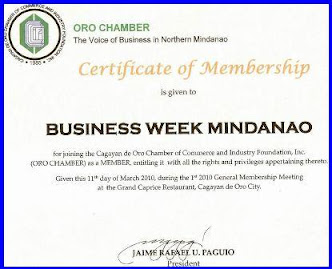
2) NEW ORO CHAMBER MEMBERS. BusinessWeek Mindanao Publisher Mr. Dante Sudaria, Reynaldo Kangleon, general manager of Fast Laboraries, Erna Maagad, officer-in-charge of Equicom Savings, Luz Gonzaga Ramos, business development officer of Sameah Travel and Tours, and Noel C. Martinez of Barkadahan Grill, take their oath as new members of the Cagayan de Oro Chamber of Commerce and Industry Foundation, Inc. (Oro Chamber) during its First Membership meeting of the year at Grand Caprice Restaurant, Limketkai Center, this city, on Thursday. PHOTO BY ROLANDO SUDARIA

OUR ADVERTISERS

Name:
Give Us Your Feedback
Email Address:

Get your own free form like this one.

  © Blogger templates The Professional Template by Ourblogtemplates.com 2008

Back to TOP