



Related Posts with Thumbnails

Sunday, February 28, 2010

Lake Lanao low water level threatens to worsen power shortage


WATER level at Lake Lanao, the primary source of Mindanao electricity grid, has reached its critical level, threatening to worsen the island’s lack of power supply.
Lake Lanao in Lanao provinces is the place where the six Agus plants are
located.
The Agus plants, which are very dependent on fresh water of Lake Lanao, are badly affected.
The water level of Lake Lanao is already down to 699.34 meters from 699.66,with a difference of 0.32 meters.
Todate, the power generation capacity of the Agus plants are reduced. Agus 1 was reduced from 80 megawatts (MWs) to 32 MWs; Agusan II from 180 MWs to 60 MWs; Agus lV from 158 MWs to 120 MWs; Agus Vl from 200 MWs to 141 MWs; and Agus VII from 54 MWs to 31 MWs.
Also, currently, Agus V was temporarily shut down to undergo repairs.
On the other hand, the Pulangi Hydroelectric power plant in Bukidnon province also reduced its power capacity from 255 Mws to 135 MWs.
The lower water level of the tributaries of Pulangi River – the Bobonawan river, Muleta River, Tigwa River, and Manupali River, also attributed the reduced power capacity of the Pulangi hydroelectric power plant.
The receding water level of Lake Lanao and Pulangi River has forced the National Grid Corp. of the Philippines (NGCP) to resort to power load curtailment scheme of rotating power cut in almost all key cities and provinces in the southern island since Feb. 9, this year.
Pedro Ambos, officer-in-charge of the operations and planning department of the National Power Corp.-Mindanao Grid, said El Nino phenomenon also aggravated the situation and would mean more power outages.
“This is nature, lower water level aggravated our power supply. We must follow the power curtailment imposed by the NGCP,” said electric cooperative official in Agusan del Norte Engr. Noli Namocatcat.
Meanwhile, the various chamber of commerce and industry in Northeastern and Northern Mindanao on Thursday reiterated their call on the national government to fast track the construction of more power plants in Mindanao.
Various business chamber in the two regions said millions of pesos were already lost due to severe power crisis.
Cagayan de Oro Chamber of Commerce and Industry president Ralph Paguio said industries were already losing money because of the power outages.
The various association of mining, wood and agriculture industries in the Caraga region also asked the national government to mobilize all power barges stationed at various areas in Mindanao.
“They (government) must fast-track the repair of Agus V plant in Lake Lanao to help support the power capacity in the region,” said a wood firm owner of this region’s capital city. (PNA)

Read more...

Let it be

THINK a minute.
There once was a village that had a very wise old man who gave the people answers to their problems.
One day a farmer came to him and said: “Wise man, my donkey has died and I have no animal to help me in the fields. This is the worst thing that has happened to me.” The wise old man answered: “Maybe. Maybe not.”
The next day, the farmer found a strong horse wandering close by his farm, so he caught it to replace his dead donkey.

His new horse was actually a much better worker than his old donkey!
The farmer was very happy and went back to tell the wise man. “You were right, wise man! Losing my donkey was not the worst thing that happened to me. I never would have caught my new horse if my donkey had not died. This is definitely the best thing that has happened to me!” The wise man answered: “Maybe. Maybe not.” The farmer was a bit irritated and thought not again! What is this wise man thinking?
A few days later, the farmer’s son was thrown off the new horse. The son broke his leg and could not help his father work on their farm. The farmer thought, “Now we’ll starve to death!” So he went back to the wise man and said: “How did you know that catching my horse was not a good thing? This time I’m sure that this is the worst thing that could happen to me!” But again, in a kind voice, the wise man answered: “Maybe. Maybe not.” The farmer was very angry at the wise man for his same foolish answer.

The next day, a war broke out. And the army came to take every healthy young man to fight as a soldier in the war. But the farmer’s son was the only young man in the village who did not have to go fight, because of his broken leg. The farmer’s son would live!

You see, if you and I will simply put our life in God’s hands and trust Him, even when bad things happen, He will work everything together for our good in His time and way. So why not ask Jesus Christ to take charge of your life today and every day of your life? Then, you can have that kind of peace and confidence.
Just Think a Minute.

Read more...

Advance advertising tactics


THE best thing about guerilla marketing is when you don’t get to spend much for your marketing efforts. However, this will work only for small and medium businesses such as yours. One of my buddies asked me why I think it won’t work for bigger companies.
The answer is simple––when you’re a big company, you have big competitors too. These big competitors have bigger budgets on their arsenal and if you don’t––you’d be at the bottom of the food chain.

Small and Medium Enterprises (SME) eventually goes big because of marketing efforts, this means that you now have a bigger cash flow and bigger advertising budget.
In turn, the competition you have had during your SME days might be on your tail too. Does this call for drastic measures? Of course not. Keeping your competition out of the spotlight is a big mistake.
My take on this is when you have competition, don’t just pray they’d go away––learn their ways, use it against them. Sounds drastic right?, but no, this is just the way things are. You need to have a friendly competition with your rivals.

The best part of a marketing effort is when you know what to put in your advertising campaigns. This is where the tactic of getting to know your competition kicks in. The more you know about your competition, the better chance you’ll have at gaining grounds. Here in Cagayan de Oro City, the word “advertising” is either misused or over-used.
In advertising, there is what we call as the advertising triad, or in a sense, the advertising quad. Advertising comprise of 3 main key points––the advertiser, who pays for all the expenditures; the advertising agency, the one who does the concepts, designs, leg work and media planning; and of course the media, where we place our advertising collaterals.
There is a spin-off point in the triad making this a quad––the advertising suppliers (AS), who handles all the printing, production and basically everything we need for materials. The fourth key point is what we have a lot of here in the city. 

Advertisers go directly to the advertising supplier and in-turn have their designs put into production there, it’s not that these AS’s can’t handle the layout and printing––they can that’s why they exist.
It’s just that, advertising materials need careful planning and design to make it work––this is the job of the advertising agency. 

These advertising agencies have the technical know-how and design savvy to boost your marketing efforts; this is why corporate giants have their own advertising agencies.
I’m not telling you to go and make your own ad agency, instead find one that’s within your reach and will extract the best in your product lines and use them to design and produce real strategic and worthwhile ads. They have the capacity to make your designs work. 
       
AS’s only have a layout artist whom they rely on for your designs and just basically transfer your initial ideas into the computer. Advertising agencies are more than just that––they conceptualize out of the box ideas that will work for your marketing efforts. The thing is, as an SME you only have so much in your budget that you will opt to go directly to the AS’s. 

We’ll leave it at that for now, try out a different perspective other than yours––I’m sure if you go to an advertising agency and have them take care of your concepts and designs, you will have a load off your work leaving the dirty jobs to the ad agency. Thanks for reading.
Live Life, Rock On!
***
I’d love to hear from you. Email me at shaun_alejandrae_uy@yahoo.com

Read more...

Micro-agri loans for farmers

THE ongoing El Niño phenomenon has truly taken a toll on our local farmers. Television newscasts and the banner stories of newspapers describe in vivid detail how the extreme heat brought about by the warmer-than-normal sea surface temperature in the Pacific Ocean has dried up farmlands, reservoirs and waterways in the country.

The lack of rainfall and irrigation water has narrowed the options for Filipino farmers, who now use whatever water they have as wisely as possible.
The recent issuance of a Bangko Sentral ng Pilipinas circular allowing all banks in the country to offer micro-agri loans for farmers could not have come at a much better time.

Circular No. 680, which lists the rules and regulations for the provision of micro-agri loans, will provide an opening for small farmers to tap any bank for their financial needs without having to go through complicated loan application procedures.

The significance of such a circular can not be discounted. The Philippines is primarily an agricultural country with a land area of 30 million hectares, 47 percent of which is agricultural land.

According to the Department of Agriculture (DA), the country’s population is predominantly rural (70 percent of the total) and two-thirds of this population depends on farming for their livelihood.
In terms of employment, about one-half of the labor force is engaged in agricultural activities.

The DA also noted that majority of the farms in the country are small ones, averaging two hectares in size. These small farms are owned and managed by single families involved in agricultural activities ranging from subsistence to commercial production.

A typical farming system consists of major crops, with rice, corn and coconut as common base crops, and a few heads of livestock and poultry.
Sadly, small farmers often find it difficult to borrow money from banks. To be able to access bank credit, farmers usually undergo complex application procedures which require the submission of financial statements and proof of tax returns. They are also required to provide traditional collateral such as land titles, which many small farmers do not have.

Micro-agri loans can provide farmers the needed relief. Micro-agri loans will not require the usual collaterals that banks ask of their clients. Depending on the bank, farmers could present unconventional collateral substitutes such as their farm animals or crops.

Farmers who apply for loans as a group can use “peer pressure or peer support” as their collateral, or they could ask their colleagues to be their co-makers.
To be eligible for a loan, farmers should have a good track record and multiple income generation activities (aside from farming) to mitigate the risks of non-payment. Their farm activities should also have been at least two years in operation at the time of the loan.

The farmers would be allowed to borrow up to P150,000, with the bank requiring them to pay their loan on a regular (weekly, semi-monthly or monthly) basis.
Farming in itself is risky: a good harvest depends on the weather, the climate, and the absence of pests. With the looming El Niño phenomenon, our farmers now need all the help they can get.
--------------
For comments and suggestions, please email totingbunye2000@gmail.com.

Read more...

Caregiver in the US


ALTHOUGH the work is often misunderstood, working as a caregiver is really one of the noblest jobs in the US.
Some misinformed people look down on caregivers maybe because they do not know the love that is being put into the care of another person.

They also do not know that  an average caregiver earns anywhere from $120 to $150 a day or $3,600 to $4,500 a month.
In Philippine pesos that would be roughly PhP165,600 to PhP207,000 a month at the exchange rate of 46:1 without deductions.

What’s more, the caregiver pays no rent, no utility bills and meals are most of the time free.
With that income, a caregiver earns more than that of a bank manager in Cagayan de Oro. 
Not all caregivers earn that much.  The unlucky ones earn only $60 a day which is $1,800 a month or PhP82,000 pesos. 

That is still better than some Cagayan de Oro bank managers. The lucky caregivers earn as much as $300 a day or $9,000 a month. 
That would be something like PhP414,000 a month in pesos.
That’s the salary of a medium Philippine corporate president.
Just what is the job of a caregiver? It varies.
The lucky ones are called companions.
They are hired only to keep company.

The boss is usually an elderly who lives alone.  When the boss travels, the caregiver also travels.  Sometimes they go together to concerts and socials.
It should be noted that not all caregivers do that.
Most caregivers take care of the elderly and do light housekeeping, laundry and cook.  Cleaning the house is done with a vacuum cleaner.

Doing laundry is done by washer and dryer machines.  Washing dishes is by machine too.
Of course, some prefer to do it by hand.
The caregiver also gives prescribed medicine to the elderly.
For the bed-ridden patients, the caregiver assists in bathroom functions.
This is where it can be messy and looked down upon.
But if you earn so much, why not.  I know of a couple who paid off their house mortgage in the Philippines working as caregivers in New York.

The unlucky caregivers would be caring for a patient with dementia.
This is the most challenging because the patient has the mentality of a child and will scream at the caregiver with harsh and insulting words.
But the seasoned caregiver would not mind the insults because the caregiver knows that the patient has the mind of a child. 

In the US, children in general don’t live with their parents.  So the parents or surviving parent hires a caregiver.
Normally, being together for a long time,  the bond between caregiver and patient gets closer so much so that in some instances, the patient would leave properties and money to the caregiver. Those are rare instances though.
And that’s as far as I know about caregiving.

Read more...

Saturday, February 27, 2010

Cagayan de Oro Mayor attends to different activities


MINI-ARMALITES TURNOVER. Mayor Tinnex Jaraula hands over one of the 12 units of brand-new mini-armalite assault rifles to City Police Director Benedicto Lopez and his deputy Col. Antonio Montalba during a simple turnover at the City Mayor’s Office, Feb. 22. Mayor Jaraula hopes that the city’s acquisition of the rifles will boost local police capabilities in deterring criminalities.                           


CDO GETS 5 MINI-DUMPTRUCKS. Mayor Tinnex Jaraula leads the blessing of the five newly-acquired mini-dump trucks worth P1.8 million shortly after City Hall flagraising ceremony on Feb. 22. Three units will be used for the City Public Services Office’s garbage collection while the two will be deployed to the Barangay Assistance Center (BAC).                                                                        
 ‘WE ARE THE CHAMPIONS’. Mayor Tinnex Jaraula and City Schools Division Superintendent Dr. Myrna S. Motoomull pose for posterity with the triumphant TEAM CDO athletes and coaches who won the recent 2010 Palarong Pampook overall titles in both elementary and high school level during presentation at City Hall, Feb. 22. - CIO                                                                     

Read more...

Hagedorn drives electric tricycle


Puerto Princesa Mayor Edward Hagedorn tests the electric tricycle prototype owned by businessman Dave Drewbre on 25 February 2010.  Hagedorn envisioned that all motorized tricycles in Puerto Princesa, Palawan would be converted to electric type in the near future to reduce pollution in the island. (Photograph: Voltaire Domingo/NPPA Images)

Read more...

Bridge project in Pikit

In Barangay Pamalian and adjacent barangays in Pikit, North Cotabato, residents used to be able to cross Paidu Pulangi Creek (left) only by wading or riding in boats. Now that a new barangay bridge (right), has been built by USAID's Growth with Equity in Mindanao (GEM) Program in partnership with the Pikit municipal government, the community is assured of the safe, reliable transport of people and farm products across the creek. Through its Barangay Infrastructure Project (BIP), GEM has built more than 900 community infrastructure facilities in conflict-affected areas of Mindanao, including water systems, solar dryers, boat landings, footbridges and bridge, and roadway upgrades. The GEM Program is implemented under the oversight of the Mindanao Economic Development Council. GEM

Read more...

THROUGH THE DIGITAL DOORWAY

The students of Momungan Academy, in Barangay Momungan, Balo-i, Lanao Del Norte, can now do online research, establish email accounts and communicate with other students throughout the world using the computers and wireless broadband internet access provided by USAID’s Growth with Equity in Mindanao (GEM) Program through its Computer Literacy and Internet Connection (CLIC) project. The GEM Program, which is implemented under the oversight of the Mindanao Economic Development Council, has provided CLIC assistance to 895 schools in conflict-affected areas of Mindanao with a combined enrollment of more than 700,000 students. GEM

Read more...

Friday, February 26, 2010

ORO CHAMBER member gets grant

Salay Handmade Paper Ind., Inc. (SHAPII) was among the lucky applicants for a training grant from the Association for Overseas Technical Scholarship (AOTS) in Japan.

The AOTS through ORO CHAMBER’s umbrella organization in Manila— the Philippine Chamber of Commerce and Industry (PCCI) conducted a screening last February 4 to ascertain successful grantees for its Logistics Management for Philippines (ENPL) Training Program.

SHAPII, a long-time member of the ORO CHAMBER, is one of the 25 privileged grantees that will undergo a two-week extensive training in Yokohama, Japan starting March 3.

The Program is designed for the participants to gain an understanding of the role of logistics experts and acquire practical methods which are applicable in the Philippines. The Course contents include 1) Logistics and Productivity Improvement (Cost and Service, Inventory Control, 5S, Packaging, etc.), Transportation, Responsible Concern for the Environment & Application of Logistics Management, Information System of Logistics, Key Performance Indicator of Logistics and Case Studies. Scholars will also have the chance to do site visits to logistics companies in Japan.

Your browser may not support display of this image. Your browser may not support display of this image. Salay Handmade Paper Industries, Incorporated (SHAPII) is an exporter of handmade paper products that is based in the quaint town of Salay, Misamis Oriental, Philippines. Headed by Mrs. Loreta Rafisura, it began in 1987 as a civic organization known as People's Economic Council (PEC). The mission of SHAPII is to help provide livelihood to the people in Salay.

Read more...

Wednesday, February 24, 2010

GSIS adds power, benefits to eCard with UMID compliance

The Government Service Insurance System (GSIS) further empowers the eCard, the all-in-one utility card of its members and pensioners, by making it 100-percent compliant with the Unified Multi-Purpose ID (UMID) System.

The GSIS will soon introduce the UMID-compliant eCard, replacing the eCard Plus. Replacement of the card, according to the pension fund, will be free.
And because it is UMID-compliant, the new eCard will already bear a Common Reference Number or CRN. The CRN is the primary identifier of an individual transacting business or availing of services from any government agency.

With the CRN, the UMID-compliant eCard will serve as a valid identification card not only for the GSIS but also for the Social Security System, Philippine Health Insurance Corporation, the Home Development Mutual Fund (HDMF) and other government agencies.

The UMID system is an offshoot of Executive Order No. 420 which requires all government agencies and government-owned and controlled corporations to streamline and harmonize their identification systems through the use of a unified multi-purpose ID.

With the use of a single identification system, government agencies, such as the GSIS will be able to get rid of redundant databases.
The UMID system will also enhance the integrity of state-issued ID cards, facilitate the public’s transactions with the government, and cut costs from producing different IDs.

Since the birth of the eCard in 2004, it has already evolved into the most technologically advanced card in the country today.
The eCard Plus, whose earliest functions was just an identification and an ATM card, is now a transaction card, a hospitalization card, an education benefit card, and a discount card.

Active members can apply for different loan products (Policy Loan, Cash Advance, ConsoLoan), while pensioners can renew their active status (ARAS) and apply for a pension loan using the GSIS eCard through the G-W@PS kiosk.

GSIS members and pensioners can also withdraw proceeds of pension, claims, or loans using any ATM worldwide.

By also presenting their eCard at any GSIS partner hospital, members and pensioners can get up to 50 percent in discount with the help of the GSIS Hospitalization Support Program (GHSP).

Recently, the GSIS has also tied up with Pfizer to give eCard holders up to 55 percent discount on selected Pfizer-manufactured drugs if they present their eCard along with their prescription in over 1,800 participating drugstores and pharmacies nationwide.

In addition, the eCard is also now an education benefit card. By simply presenting the eCard, qualified relatives of GSIS members and pensioners, who are going to enroll as incoming freshmen in any STI campus nationwide can already benefit from a twenty percent (20%) scholarship grant on tuition and laboratory fees.
With compliance to the UMID system, the GSIS adds more power to its pioneer project. All the above features, according to the GSIS, will be retained by the UMID-compliant eCard.

Apart from the GSIS, other government agencies moving into UMID are the SSS, Philhealth, and the HDMF.

Read more...

Monday, February 22, 2010

AboitizPower takes over first of 2 Mindanao power barges

ABOITIZPOWER, through wholly owned subsidiary Therma Marine, Inc., (TMI) recently assumed ownership of PB 118, a 100-MW power barge moored at Bgy. San Roque, Maco, in Compostella Valley.
 
  The bunker-fired generating facility is one of two power barges acquired by AboitizPower after it won a negotiated bid conducted by the Power Sector Assets and Liabilities Management Corporation on July 31, 2009. The total purchase price for both facilities is USD 30 million. PB 117, also with a generating capacity of 100 MW, is moored at Nasipit, Agusan del Norte and scheduled for turnover on March 1, 2010.

TMI has an Ancillary Services Procurement Agreement with the National Grid Corp. of the Philippines to support the running of the plant. However, the agreement is subject to approval by the Energy Regulatory Commission.
  AboitizPower president and CEO Erramon Aboitiz said, “With PB 118 we provide ancillary services for Mindanao but still have power available for sale to utilities and cooperatives in the area.”

  Notwithstanding the full operation of PB 118, which was commissioned in August 1994, Mindanao will still continue to suffer rotating brownouts due to low water levels at Lake Lanao, the main source of power for the Mindanao grid.

  AboitizPower is the holding company for the Aboitiz Group’s investments in power generation, distribution, retail and power services. It is a major producer of renewable energy in the country with several hydroelectric and geothermal assets in its generation portfolio. The non-renewable portfolio consists of plants throughout the country. The distribution utilities it owns and operates are located in Luzon, Visayas and Mindanao. 

The PB118, 100-MW power barge is moored at Bgy. San Roque, Maco, Compostela Valley in Mindanao.

Read more...

Festival of rituals


By Joe Palabao
Correspondent

“GIVING faces and voices to the rich culture of the Manobos, Talaandig, Higaonon and Bukidnon tribes of Kiokong, original name of Quezon, in Bukidnon highlights the Festival of Rituals celebrated every second week of February to preserve their rich culture for generations.”

  The main highway thoroughfare and streets of Quezon came alive as the foreign tourists, thousand of lumads dressed in traditional costumes coming from the 22 barangays of the town, with eight tribal chieftains, residents, town officials, dignitaries and guests gathered to watch the colorful Civic-Cultural Parade and Ethnic Street Dancing marking the SUNGGOD TA KAMANGA Festival, a grand thanksgiving celebration of the tribes held February 13-14.
  The tribes in full bright colored regalia together with the tourists, visitors and guests filled Dona Resing Park as they moved from one booth to another to see the yield of their bountiful harvests, cultural exhibits/the indigenous handicrafts and livelihood products of the tribal folks from ticus, beautifully woven backpack, native mats, decors and rattan sala set displaying their craftsmanship. 
  Festival of rituals and tribal traditional songs and dances were witnessed and enjoyed by the visitors as the different tribes performed the Ulaging- a dance and song worship to the Magbabaya.
  The songs and dances depicted their rich tribal costumes and traditions down to the pre-festival preparation for a rich and bountiful harvest wherein their farm tools, implements and other household paraphernalia were displayed for blessings from the Magbabaya and the dance for a bountiful harvest where the yield of the farms were displayed and being cooked like chicken, fresh water fish, root crops, vegetables and other native food as a sign of a bountiful harvest from the richness of the land the till. And to make the ritual so meaningful, the tourists, the visitors and guests together dined with them and savored the native food with gusto. 
  Deri Husi Tribal Band conquered their Freedom Park as they provided tribal songs from soft to rock tribal music enjoyed by everybody and the Tribal Disco which rocked the town and enjoyed by thousand of lumads, young and old alike dancing to the beautiful sounds of the tribal instruments.
  Laro ng Lahi showcasing traditional ethnic sports exhibition were witnessed b he tourists and guests on the last day of the festival.
  Games like Bag-id ha Kagtulro from making fire to cooking rice inside a bamboo tube called Kalumbo, Babayo Ta Para HLubok sa Humay by producing clean rice and other tribal household activities. Duso a human tug of war, a game using strong piece of stick wherein the lumads show their strength by pushing one outside the circle and be out.
The winners are then considered having strength and can give security to tribal women. The traditional Galing Ta Bato hu Kamais (corn grinding using stone grinder) mesmerized the crowd how the tribal women with precision put the corn kernel to the grinder and produce white corn grits ready for cooking.

Read more...

Sunday, February 21, 2010

Rufus: Give Arroyo emergency powers

By LEN VELASCO, Reporter
and BONG FABE, Contributor 

THE government will seriously consider the motion of Cagayan de Oro Rep. Rufus Rodriguez for President Arroyo to declare Mindanao under the state of power crisis and convene Congress in a special session to address the looming power shortage on the island.

  During a House committee on energy hearing last week, Rodriguez crossed party lines by calling congress to give President Arroyo emergency powers to avert the disaster that maybe brought about by the power crisis. Rea More


Read more...

SLERS looks to greater heights for 2010

CAGAYAN de Oro’s leading meat processing company is looking expand the distribution of  its products all over Mindanao in 2010 with a wider network of dealers, franchises and direct dealerships.
  “We are in the business of developing entrepreneurs,” says Mercedes “Litlit” Pelaez-Mejia, managing director of SLERS Industries, Inc. who was cited  as one of “The Ten Outstanding Entrepreneurs of 2008” by Entrepreneur Philippines, a Summit publication. “We have succeeded so far due to people who made our business their business. It is this spirit of enterprise which drives SLERS.”
  To do this, Mejia is banking on a four-fold thrust which includes expanding distribution of its top selling tocino to more supermarket in Davao, Butuan, Pagadian, Ozamiz, Dapitan and Dipolog through the use of the ‘takal-takal’ (the equivalent of the carenderia’s turo-turo now adopted by the country’s leading meat companies); adding more franchises of its famous SLERS PiCA-PiCA kiosks bannered by the ubiquitous SLERS Chicharon (pork rinds); franchising its SLERS Ham & Café outlet; and tapping more direct dealerships  run by entrepreneurs.
  Eventually, the expanded operations would require expanded production facilities which would commence with the groundbreaking a new five hectare production plant in Ala-e, Manolo Fortich, Bukidnon in 2011.
  SLERS present 600 sq.m. production facility in Gusa, Cagayan de Oro started as a cottage industry and would not be able to keep up with the projected volume of expansion envisioned for the next five years. It also has a 300 sq.m. chicharon production facility nearby.
  “Our new factory would be a HACCP (Hazard Analysis Critical Control Point) certified facility accredited by the National Meat Inspection Service (NMIS),” Mejia said.
  Besides upgrading its production facilities, Mejia is also implementing the gradual professionalization of SLERS, which was started as a cottage industry in 1969 by her mother Ofelia ‘Fely’ Cosin-Pelaez, now vice president and charged with the quality control of the firm’s products.
  “We have to professionalize the company,” Mejia said. “There is no success without a successor,” she added, in reference to the company’s thrust to recruit and develop key personnel for all aspects of its operations.
Besides being recognized as one of “The Ten Outstanding Entrepreneurs of 2008” by Entrepreneur Philippines, Pelaez-Mejia was also cited by co- Globe Business as its Globe Masigasig Entrepreneur and featured in the January 2008 issue of Masigasig a special publication for small, medium and micro businesses made by Summit Media for Globe Telecom.

Read more...

SMEs can now track deliveries, personnel with PLDT FASTrack

ENTREPRENEURS usually have little control over what happens to their goods while these are in transit during deliveries—often, they have no choice but to simply put their trust and faith in their field personnel and delivery staff. 

  Yet, some nagging questions remain: Will the goods arrive on time? Why did it take so long to deliver? Is it really because of traffic or because of unnecessary stops and detours? Or worse, what if the delivery is stolen or hijacked?  But what if there was a way to know your delivery vehicles’ location right at this moment? What if there was a way to track whether they are stalled or stranded, and what route they are taking? What if you could even monitor whether parked vehicles are being started and moved without authorization? 

  Now, thanks to PLDT-SME Nation’s FASTrack service, entrepreneurs have the means to track the movements of their company vehicles and even their field personnel, resulting in improved safety, security and cost-efficiency. Essentially, F.A.S.Track is a high-tech service that allows SMEs to track and monitor the location of company vehicles and personnel as they travel en route to their set destination. 

  FASTrack uses a portable, pocket-sized homing device that is wirelessly connected to a GPS (Global Positioning System) network. The network relies on satellite navigation technology to monitor the location of business field assets; providing on-the-road, real-time tracking of delivery personnel and vehicles. 

  “PLDT FASTrack is specifically designed to help SMEs track their vehicle-carrying goods while in transit. Its features and monitoring tools enable business owners to determine the whereabouts of their fleet or vehicles thus allowing them to extract maximum efficiency and productivity from their employees,” says PLDT SME-Nation Vice President and Head Kat Luna-Abelarde.  

  PLDT FASTrack would be of great benefit to companies that require delivery of goods as part of their operations such as manufacturing, wholesale and retail trade; security and investigation; and service and utility companies.   

  “This simple device can offer a number of features that protects your business from bad elements and illegal operations that most business owners fear when it comes to transporting goods. Even their field agents can carry the device along with them,” says Amil Azurin, PLDT SME-Nation Marketing Head. 

  “PLDT FASTrack provides a managed end to end vehicle monitoring solution. It comes with the tracking device, the monitoring software and it runs on the PLDT & SMART’s network as well. This way, the client won’t be burdened with the hassle of talking to different vendors or providers,” she said. 

  A detailed Graphical Map interface (displayed on a personal computer or laptop) provides details on the whereabouts of field staff and vehicles (or even an entire transport fleet) using an easy-to-understand GPS-surveyed digital map. It can pinpoint the exact location of on-the-road agents up to the secondary street level. 

  The PLDT FASTrack system can even send updates and alerts to a business owner’s mobile phone, regarding his vehicles’ and personnel’s whereabouts.  “PLDT FASTrack unit is designed to provide reliable data on the whereabouts of any vehicle. Its rugged design can withstand the conditions of long travels and its small size allows it to be concealed inside your car for discreet implementation,” says PLDT-SME Nation Product Manager Christian Lim. 

PLDT FASTrack eases stress for any business as it gives owners hands-on, real-time information for smoother and worry-free field operations.

Read more...

Generics Pharmacy launches 6 franchise outlets in C. de Oro

By Joe Palabao, Correspondent

GENERICS Pharmacy made a grand launch in Cagayan de Oro last February 12 with the opening of its six new franchise outlets in various areas in the city.

  Now numbering 730 outlets nationwide, Generics Pharmacy simultaneously opened stores at Gaisano Mall, Carmen market, JR Borja-Cogon, Osmeña St., in Barangay Puerto and at the Divisoria Plaza.

  During the launching ceremonies, customers buying their generics medicines were provided free services like blood pressure checks and blood glucose tests.
  Generics Pharmacy, named as one of the Ten Outstanding Entrepreneurs in the Philippines today and was awarded as “The Most Promising Filipino Franchise of the Year 2009,” has surged to become one of country’s most promising franchising business.

  But before its runaway success, the company has had decades of experiences in wholesale distribution of medicines and other pharmaceutical products to drugstores, hospitals and factories. 

  Parlaying that experiences into providing quality yet affordable medicines to thousands of Filipinos - and livelihood to hundreds more enterprising Pinoys through franchising - has been the job of the Generics Pharmacy’s president and CEO, Benjamen Liuson, for the last 35 years.
  Liuson joined the company shortly after his father’s death. Before that, in 1960, his parents bought the company from its original German owners, who founded the firm in 1949. 

  He continued the family business, selling about 50 pharmaceutical products to big-volume buyer, until he planted the seeds of the Generics Pharmacy’s future success in 1982. That was when the company began selling generic medicines wholesale, seven (7) years before The Generics Act was signed into law in 1980. 

  However, it wasn’t until 2001 when Generics Pharmacy, seeing the need to serve patients from low-income groups, went the retail route and opened its first and only company-owned drugstore at its head office on Quezon Avenue in Quezon City. 

  Banking on its strength on distribution,
  the company opened its business to franchising in 2007. Incredibly, franchisees own the rest of the Generics Pharmacy’s 500-plus branches and people are still buying into the company. They are now operating into 200 outlets a year. 

  The generics company aimed at running the country’s largest retail drugstore chain within the next two years by growing more than 1,000 outlets. The franchisees get their investment-ranging from P650T to P850T -back in one to two years. 

  Through the franchising model, Generic Pharmacy has thus served cash-strapped customers who need not to go all the way to Manila from the provinces to buy generic medicines. They have now have outlets as far as Tawi-tawi in Mindanao, carrying some products that serve 90 percent of the mass market’s medicine requirements. They only sell generics, not branded medicines.
  The Generics Pharmacy has grown so rapidly in two years, with a 300-percent increase in sales from 2007. 

  It is of the fact that their products, made from branded preparations, are effective yet low priced.
  Paracetamol for instance costs just one-fifth of what it would be priced at other drugstores. It has attracted budget conscious consumers partly because its shops are usually located near more established drugstore that carry branded medicine, and provide services like free blood pressure checks and blood sugar tests for only P25. Selected outlets also offer free medical check-ups. 

In addition to all these services, their business itself is a form of corporate social responsibility, which is why the prices of the Generics Pharmacy’s medicines are kept stable, regardless of demand or shortages in stock. They have been offering low-priced medicines even before the Cheaper Medicines Act was enacted. With its number of branches increasing everyday, more clients will patronize the Generics Pharmacy.

Read more...

Del Monte backs Safe River project

By Joe Palabao, Correspondent 

FOOD giant Del Monte Philippines, Inc. (DMPI) has expressed its full support to the “Piso Para sa Suba sa Cagayan de Oro” project which is intended to raise fund for the protection, rehabilitation and preservation of the Cagayan de Oro River.

  During a recent Technical Working Group (TWG) meeting held at Liceo de Cagayan University, DMPI’s Human Resource Department head Ophelia Condeza turned over 287 pieces of tin cans to the school’s Safer River, Life Saver Foundation, Inc. (SRLSFI) to be used as donation cans for the project.   

  The proceeds will go to the clean-up drive, river patrol monitoring, coastal clean-up, tree growing, bagging/potting, feeding program organized by SRLS Club, eco-tourism-river tour, fingerlings dispersal and livelihood projects, said SRLSFI executive director Rosalinda Huerbana, who also received the tin cans donation. 

  The turn-over ceremony was witnessed by members of the Technical Working Group who dropped their respective ceremonial coins and bills to signify the start of the project.
  Huerbana said the donation tin cans will be distributed and placed in strategic places like the schools, private and government offices. 

  She said the foundation needs fund to sustain its programs and projects that include the giving of incentive prizes for outstanding barangays and individuals in their support to the foundation’s program.
  Institutional members present include regional offices of NEDA, DENR, DPWH, DOT, DILG, BFAR,
  city government, CLENRO, City Planning, College of Arts and Sciences/LDCU, APO Kauswagan, Del Monte Philippines, Inc., BusinessWeek Mindanao, City Tourism, Liceo Net /LCDU, Zealep Advertising, City Agriculture Office, HRMC/LDCU, City Tourism, City Engineer’s Office, and City DILG, Office, City Building Office, City Tourism and City Public Services Office.
The meeting likewise tackled the Committee Annual Action Planning which include the holding of a River Summit within the year to address the concerns for continuous protection, rehabilitation and preservation of Cagayan de Oro River and other rivers in Misamis Oriental.

Read more...

Regional films at its finest

GREETINGS from the Cultual Center of the Philippines. It’s my second year to be part of the CINEMA REHIYON component of the Philippine International Arts Festival. It is the gathering of regional filmmakers from all over the Philippines.

  Cinema Rehiyon’s theme is well put as its aim to bring forth new generations and new breed of filmmakers apart from those of the Manila mainstream film industry. Since it’s my second time here at CCP, I got to meet old friends from last year and new ones from this year’s leg. It is pretty overwhelming.

  Cinema Rehiyon is spearheaded by the National Commission for Cultural and the Arts under the leadership of the head of committee on cinema-Dr. Mike Rapatan and festival director, Mr. Gabby Fernandez. The films curated come from Bacolod,Baguio, Calabarzon, Cebu, Bohol, Iloilo, Pampanga, Naga and of course Northern Mindanao which I am representing for the second straight year. I am with the curator for Cagayan de Oro - Iligan films, Mr. Hobart Savior and young filmmakers from Iligan, Glenmark Doromal and Catherine Codas.

  The experience is great, we get to spend time with filmmakers from other regions. they tell us stories that somehow takes to their place and how beautiful their culture is. we met peque gallaga too and direk lore reyes, this was one opportunity i would cherish for all time. we learned a lot from him when he had a small converstation with us northern mindanaoans. to note: he said that our film culture is growing and that we should hone it, and even said he loves going to cagayan de oro.

  The films from the regions are mesmerizing, some wer more visual than narrative but the important thing was that they told their stories - and that is the most important part. films must evolve around stories not commercialism, fresh new plots should be brought to life as this is the spirit of true independent film making.

  My film pili-ay was recieved widely and i got praises from the audience with matching photo opp. hehehehe. that is why i would like to thank my conematographer and good friend ronald mastail, lawrence babanto, my students felisa escalona - who acted for the second time under my direction, krisha dawn mainit, ivan obsioma, leah libot and steph salvador. thank you to all who supported me in this endeavor, my family, friends, and of course the almighty father. i dedicate this achievement to the fallen men  and women of the media and those who constantly fight injustice, greed and corruption.
Live life, rock on.

Read more...

Philippine elections

A LOT of Filipino-Americans, unlike before, are no longer excited watching at the proceedings of the national elections in the Philippines.

  The reasons are, according to them, the same old song, nothing changes after the activity; it introduces new suspicious political characters; it is the presentation of the thieves in the government and still nobody is prosecuted and still more and a lot of lies are presented and offered by the candidates.

  It used to be a great presentation whenever an election is held in the country.
  Filipinos in the US continent are entertained so well and every score is a big issue to watch.
  They are all thrilled by the movement of the campaigns and excited about the candidates who are running.

  It is used to be a big issue among Filipino-Americans as everyone thinks the result of the elections will necessarily change the structure of Philippine leadership and eventually improve the bad shape of the country.

  It seems many Filipinos here are no longer excited because after the elections, the new thieves in the government come in and work jointly with the old leaders who are no longer needed.
  New gimmicks and styles to rob the government are emerging and still the old system of government that impoverish the Filipinos is there and doing its old work.

  The much publicized start of the campaign for the national elections used to be big news here but it seems it no longer touch the nerves of the Filipinos who feel angrier than excited.
  Who cares, said one of the angry Filipino. Whoever comes out in the election cannot make miracles.
  The most that can happen is go back to the old system when everything is disorder and terrifying.

Read more...

Where are we heading to?

OUR world is besieged with tragedies and seemingly insurmountable odds. The very recent tragic earthquake that killed hundreds of thousands in Haiti; the calamitous floods that saw thousands of Filipinos dead and homeless; the continuing loss of lives and  communities in the deadly political - ideological - religious struggles in the Middle East, Europe and Asian countries; the ever-growing threat of economic depression all over the world which endangers even the powerful and wealthy nations, and the ever changing global climate that trigger natural disasters. 

  All these are real grim reminders that man is largely responsible for his wanton ways and material largesse.
  All indications seemed to lead to the destruction of humanity, and yet, even if this reality has stared us in the face for thousands of years, man never learned. 

  Or will we ever learn for the few remaining decades of earth’s life? If we do not change our ways and ignore the warnings of past and current history, are we heading to extinction, physically and spiritually? Are we heading to a change for a much better world than what we have today? Of course we cannot change nature’s course. 

  The Haiti earthquake could have been triggered by natural causes. But man could have lessened the impacts of such natural  occurrences. Casualties in terms of lives and properties could have been lessened in Haiti, if its buildings and infrastructures been built with higher standards (material and craftsmanship). 

  This is true in the Philippines. It is public knowledge that many government projects (buildings, infrastructures) were built with substandard materials, all for the glory of corruption. Thus when calamities come, there are more destructions than could have been prevented.
  The wars in the Middle East are unnecessary if countries and people focus more on peaceful co-existence rather than pride and religious hypocrisy. 

  Market crashes and financial losses which led to global economic recession are nothing but results of man’s greed for wealth and political power and the accompanying decadent lifestyle.
  Above all, we are continuing to ignore that global warming and climate change are man’s own doing. When will we ever learn? Is it not time yet to reconcile ourselves to Providence? At least what’s left for man after life on earth is gone, is his eternal destiny. Lets us then chart our journey towards eternity now - which we can do if we start the change within ourselves.

Read more...

Filipino-Americans

I’VE been in the U.S. for more than 30 years now.  My wife, Gerlou and I, still speak to each other the Kagay-anon way.
  Wala gyud malimot sa atong Kagay-anon na binisaya.  On the other hand, our daughter, Anjanette came here when she was still in pre-school while our son, Ryan had just learned how to talk.

  Although we continued speaking to them in our dialect, the English language was more influential to them because of television and their schoolmates.
  But they can understand our Kagay-anon tongue.  

  Their ways, however, are more American than Filipino.  And that’s the way it is among Filipino immigrants who had been here in the U.S. as long as we had been here or even longer. 
  There are 2 kinds of Filipino Americans here.
  By the way, we are referred to as Filipino Americans because we are U.S. citizens with origins from the Philippines. 

  Those who were born in the U.S. or were raised in the U.S. from infancy or from their pre-teen years are very much Americanized.  While those who came here as teenagers and up are also Americanized in many ways but they still speak their original Filipino language.
  I remember years ago, a Filipino American student leader told me that he didn’t know where he belonged.  Being raised in the U.S. he said he was out-of-place among the Filipino students who spoke Pilipino because he couldn’t speak the language. Although he spoke the English language fluently with no Filipino accent, he also didn’t belong to the main stream Americans because of the color of his skin.  In other words, he had no barkada. That was years ago.  Today, there are many Filipino Americans born and raised in the U.S. just as there are many who are still fluent with the Pilipino language.

  Mature Filipino Americans like me who had lived here in the U.S. for so long, had consciously or unconsciously acquired some American culture.
  When we drive our vehicles we strictly follow traffic rules; we immediately make a line when a crowd is formed to buy something; we treat our pets like they are part of the family;  we are careful not to throw our trash anywhere;  we vote for candidates that our conscience tells us who are the best administrators.

  Of course, most of us are still rice eaters but most of our children born and raised in the U.S. no longer eat much of our Filipino food.  Between the hamburger of Jollibee and McDonalds, they prefer MacDo.

What I have written may sound unbelievable but that’s as far as I know.

Read more...

Case of the missing coins

FIVE years ago, the Monetary Board of the Bangko Sentral ng Pilipinas created a special committee to address the problems arising from the circulation of Philippine currency—challenges which persist up to the present.

  BSP Governor Amando Tetangco Jr., who was then the first chair of the Currency Management Committee (CuMC), stressed the importance of creating such a committee because of three main concerns: the perceived shortage of coins in some regions in the country, the indications that coins are not being circulated effectively, and the need for BSP to produce more coins to make up for those not in circulation. The production cost runs into millions of pesos.

  Last week, I discussed the main reason behind the country’s perennial shortage of coins, particularly the lower-denominated ones: the negative attitude and low regard for small currency.
  Instead of using coins to purchase goods (and in effect circulating them in the market where they rightfully belong), many Filipinos consider them as “excess baggage” and leave them at home.
  The practice of keeping coins in piggy banks for a long time also leads to this artificial, but persistent, shortage of coins.
  The BSP sees another reason behind this problem: coin smuggling.
  Dr. Paterson Encabo, head of BSP’s Mint Refinery Operations Division (MROD), explained that in the last two years, there have been some attempts to smuggle out coins, particularly 1-piso, because of the increased international demand for copper and nickel.
  Encabo explained this was because of the higher metal content of 1-piso coins belonging to an earlier series. The earlier 1-piso coin was then worth P1.50 because of its nickel and copper content.
  “However, the metal composition of today’s P1-piso coin should discourage smugglers. It is now made of nickel-plated, low-value steel,” Encabo said.
  Just the same the cost to produce the same 1-piso coin, considering metal content plus production cost, is much more. We spend approximately P1.55 for every 1-piso coin. Metal content accounts for 0.75 centavos while production cost amounts to roughly 0.80 centavos.
  Thus, coin production for the 1-piso coin would entail negative seigniorage.
  Seiniorage is  the difference between the coin’s total production cost (cost of the metal + labor) and the coin’s face value. When the production cost of the coin is greater than its nominal value (especially for the lower denominated coins, such as 25-, 10- and 1-sentimo), negative seigniorage is incurred.
  Thus the Currency Management Committee, now headed by Deputy Governor Diwa Guinigundo, continues to look for ways and means not only   to efficiently produce notes and coins, consistent with the requirements of the economy, but also to ensure that that coins are effectively circulating.
  All banks are encouraged not look at coin deposits as “labor-intensive”. Instead, banks are persuaded to even encourage their clients to deposit and save their small currencies with them.
  Both the retail sector and the Filipino public, on the other hand, should adopt a positive attitude toward our coins and make sure to use them whenever they can.

Read more...

The halal industry initiative in NorthernMindanao


LAST Friday a well organized assembly of industry leaders, government agency advocates and Islamic educators meet at Pryce Plaza in Carmen Hill, Cagayan de Oro City to lay out the organizational formation of the Halal Industry prime movers.

  Halal which is a Quaranic term in Islam means lawful or permitted. It is the opposite of “Haram” which means prohibited or unacceptable.
  The Department of Trade and Industry (DTI) is advocating the growth of Halal Producers and Consumers in Southern Philippines.

  In partnership with other government line agencies like the Department of Agriculture and the Board of Investments, it encourages economic activity which has a potential of breaking to the export market.

  Halal is bounded with HACCP and ISO guidelines in sanitation. The certification for a producer to world standards is determined by various Philippines and international certification boards that works on the parameters of Islam. The government do not certify the Producers since it is a religious matter within the purview of Islamic belief.

  The Halal industry is a catalyst to economic development in Mindanao.
  The market which goes to the Autonomous Region in Muslim Mindanao with a population of more than 22 Million to Southeast Asia and Middle East with 1.8 Billion  consumers.
  Given this data and market potential, the Halal industry will grow and become a mainstream in Mindanao’s economic endeavor.
  Among the structures the Halal meeting discussed were the identification and profiling of the stakeholders.
  The key players coming from the Cattle growers, fish pond owners and service providers such as the hotels and restaurants and the government agencies tasked to facilitate the organization set-up as well as the legal requirement  comes Director Dimasawa Dimapuro whose task of seeing the association brisk the infancy to a regional prime mover.
  To compete with the best practices in some other Muslim Asian countries.
There is so much hope and optimism to see Muslims and Christians working  in tandem to create a common economic cooperation.

Read more...

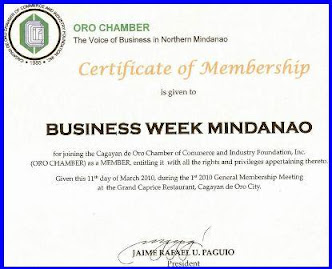
2) NEW ORO CHAMBER MEMBERS. BusinessWeek Mindanao Publisher Mr. Dante Sudaria, Reynaldo Kangleon, general manager of Fast Laboraries, Erna Maagad, officer-in-charge of Equicom Savings, Luz Gonzaga Ramos, business development officer of Sameah Travel and Tours, and Noel C. Martinez of Barkadahan Grill, take their oath as new members of the Cagayan de Oro Chamber of Commerce and Industry Foundation, Inc. (Oro Chamber) during its First Membership meeting of the year at Grand Caprice Restaurant, Limketkai Center, this city, on Thursday. PHOTO BY ROLANDO SUDARIA

OUR ADVERTISERS

Name:
Give Us Your Feedback
Email Address:

Get your own free form like this one.

  © Blogger templates The Professional Template by Ourblogtemplates.com 2008

Back to TOP